"I don't know" is never an excuse: Make an assumption and document it
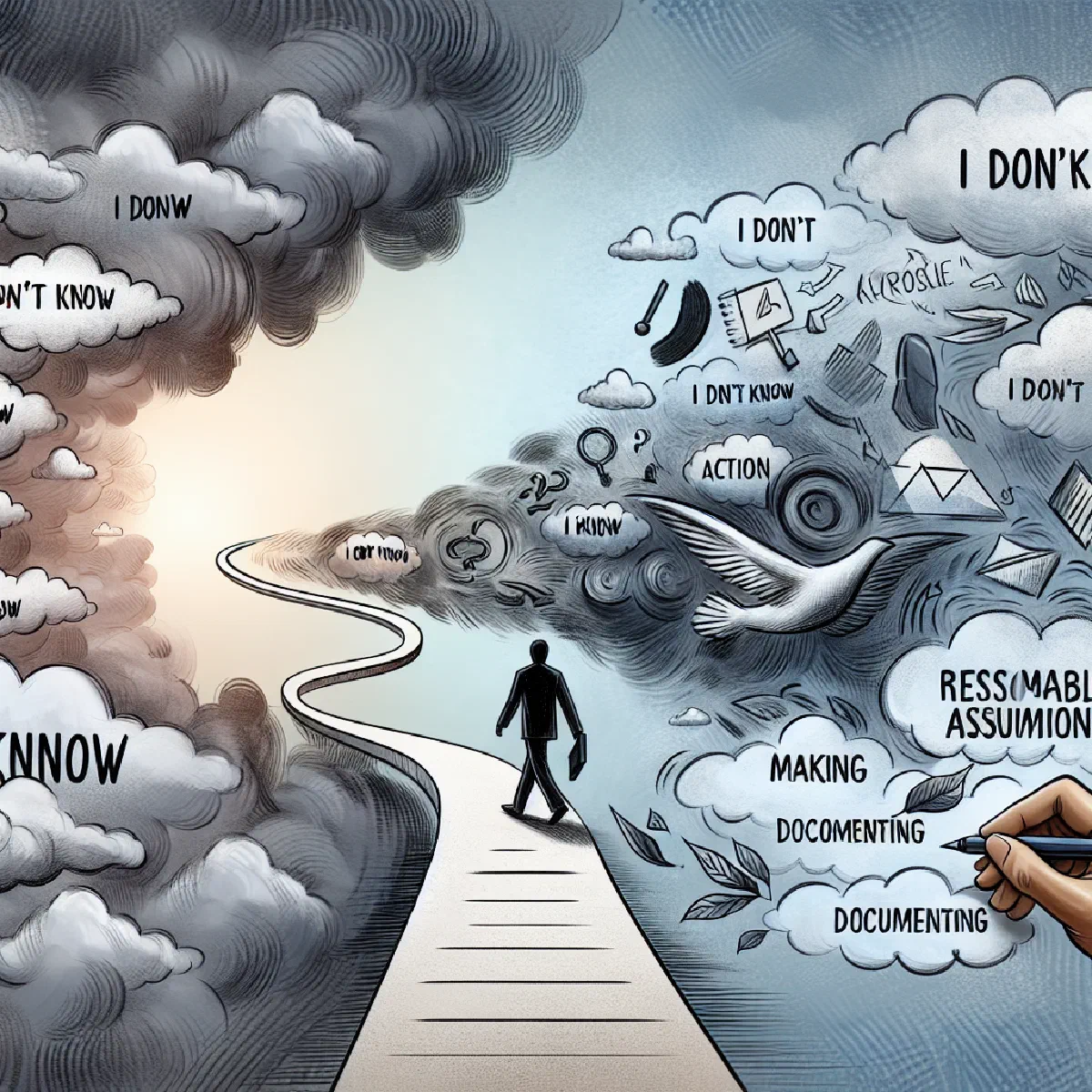
Transform uncertainty into action by making reasonable assumptions and documenting them. Embrace decision-making for progress without perfect information.
Introduction
“I don’t know” often serves as a convenient excuse for inaction. It’s tempting to defer decisions when the information feels incomplete or uncertain. But in my experience, waiting for perfect information isn’t just impractical—it’s often detrimental. Progress depends on moving forward, even when all the answers aren’t clear.
That’s why I advocate for a different mindset: when faced with ambiguity, make a reasonable assumption, document it, and proceed. This approach doesn’t eliminate uncertainty, but it reframes it as a manageable challenge rather than a roadblock. By leaning into conditional decision-making and clear communication, individuals and teams can act confidently without perfect knowledge.
The Problem with Perfect Information
Too often, people believe that action requires 100% certainty. They default to the status quo, avoiding decisions because they haven’t gathered every possible fact. This mindset is counterproductive. If everyone operated this way, nothing would ever move forward.
I’ve learned that progress rarely hinges on perfect information. Instead, it depends on the willingness to acknowledge what’s unknown, make reasonable assumptions, and communicate those assumptions transparently. By treating uncertainty as a natural part of decision-making, we can overcome hesitation and keep things moving.
Conditional Reasoning: A Framework for Action
The key to acting in the face of uncertainty lies in conditional reasoning. When I lack definitive information, I frame my decisions around “if-then” assumptions. For example: If X is true, we’ll do Y. If X turns out to be false, we’ll pivot to Z. This structure allows decisions to move forward without pretending to have all the answers.
Of course, this approach comes with responsibilities:
-
I document the assumptions I’ve made and share them with all relevant stakeholders.
-
I remain prepared to adjust if those assumptions are proven false.
-
I ensure that my communication is clear so that no one mistakes assumptions for guarantees.
This framework isn’t about being reckless or cavalier. It’s about recognizing that action, even based on incomplete information, is often better than inaction.
The Power of Documentation
One of the simplest yet most impactful tools in this process is documentation. Writing down your assumptions—whether in an email, a shared document, or a project management system—ensures clarity and alignment. It’s not about creating exhaustive reports. Even a straightforward note can make all the difference.
For instance, I’ll often send an email like this: “Based on the information available, we’re assuming X. If X is true, we’ll proceed with Y. If it turns out that X is false, we’ll reevaluate and consider Z instead.”
However, documentation alone isn’t enough. I’ve learned that many people don’t fully absorb written communication. That’s why I often follow up with a call or meeting to walk through the assumptions and confirm everyone is aligned. This step is critical to avoid misunderstandings, particularly the common mistake of treating assumptions as commitments.
Shifting Team Dynamics
Many teams struggle with this mindset because they’re conditioned to think of inaction as the “safe” choice. They believe that action requires certainty, and as a result, they push responsibility onto others or delay decisions indefinitely. In my view, this is a serious mistake. It holds back progress and undermines the organization’s ability to deliver value.
Encouraging teams to embrace assumption-based action requires cultural change. Leaders must model this behavior by:
-
Demonstrating how assumptions can drive progress without unnecessary risk.
-
Rewarding team members who take thoughtful, assumption-driven actions.
-
Showing that it’s okay to be wrong, as long as decisions are made transparently and with accountability.
Teams that adopt this mindset become more agile and effective, while those that cling to perfect information risk becoming irrelevant.
Accountability as the Anchor
Accountability is the foundation of this entire philosophy. When assumptions are documented, they create a shared understanding of what’s required for success. If those assumptions aren’t met, it’s important to hold the responsible parties accountable. For example:
-
If a client or partner fails to deliver the information that an assumption was based on, it must be clear that their inaction caused the outcome to change.
-
If an assumption turns out to be incorrect, the team must evaluate why and incorporate those lessons into future decision-making.
Accountability ensures that assumptions are not made in isolation. It creates a culture where actions are tied to clear conditions, and those conditions are revisited and tested. This isn’t about blame—it’s about creating a feedback loop that improves decision-making over time.
Conclusion
“I don’t know” is a natural response to ambiguity, but it should never be an endpoint. By adopting the principles of assumption-based decision-making—framing “if-then” scenarios, documenting assumptions, and fostering accountability—we can transform uncertainty into action.
This approach requires discipline, communication, and adaptability. But the payoff is significant: it enables progress, encourages innovation, and fosters a culture of transparency and learning.
In my experience, the choice is clear. When faced with uncertainty, don’t hesitate. Make an assumption, document it, and take the next step forward. Progress depends on it.
Nobody takes you aside anymore
Print taught a generation when to stop. What we lose when the machines absorb the constraints that used to form us.
Your AI agents need a water cooler
Coordination is a property of the room, not the org chart. What that means when your coworkers are agents.
On the death of the author and the birth of the detector
Why worrying about AI authorship is lazier, and more prejudiced, than it looks.
The work of being available now
A book on AI, judgment, and staying human at work.
The practice of work in progress
Practical essays on how work actually gets done.
Make yourself obsolete
If you’re not trying to eliminate your own job, you’re not paying attention.
Start with purpose
Transform your work by prioritizing purpose over tasks. Discover how focusing on time and intention leads to greater impact and fulfillment.
How I made Tailscale and NordVPN coexist: the Linux exit node pattern
A practical pattern for running Tailscale and NordVPN together, plus the larger question it exposed: private networks need explicit exit profiles, not one vague VPN toggle.