Article analysis: Here’s the real reason 75% of corporate AI initiatives fail
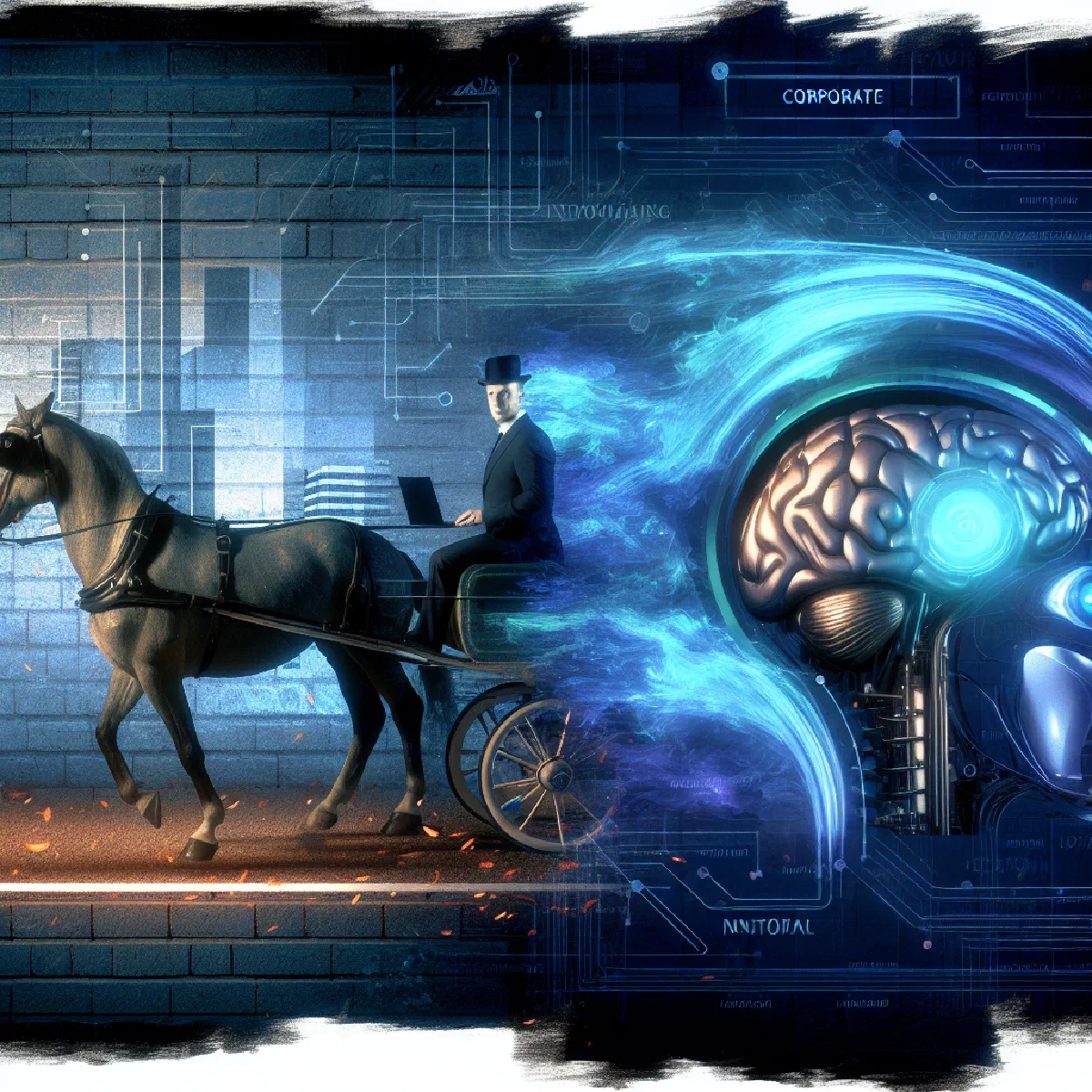
Discover why 75% of corporate AI initiatives fail and learn how to align AI with innovative business models for success in a competitive landscape.
A poignant quote from the article is:
“Companies acquiring AI without a new business model is like a company digitizing a horse and carriage—while the competition has created a digital automobile.”
This quote by Spencer Fung encapsulates the central argument that merely integrating AI into outdated frameworks is insufficient for achieving competitive advantage.
Summary
The article “Here’s the real reason 75% of corporate AI initiatives fail” explores why a significant portion of AI projects in corporations do not succeed, despite the substantial investment predicted to reach $60 billion annually by 2026. The article argues that the main issue lies in companies attempting to retrofit AI technologies into outdated business models and processes. Echoed by Spencer Fung of Li & Fung, it compares this to digitizing a horse and carriage while competitors innovate with digital automobiles, emphasizing that AI is not a cure-all and requires a reevaluated business model to be effective. The article further discusses how the volatility of global markets can render historical AI data unreliable, citing John Sicard’s experience during the pandemic where mathematical models failed, highlighting the importance of human intervention and intuition in decision-making. Insights from chess grandmaster Garry Kasparov reinforce this, suggesting that humans must know when to rely on AI and when to use their judgment. Additionally, the article stresses the need for new human skills, like creativity and interpersonal abilities, to complement AI’s capabilities, with leaders like Peter Cameron, Rod Harl, and Maria Villablanca underscoring the irreplaceable value of personal relationships and creative problem-solving. Ultimately, it suggests that successful AI integration hinges on balancing technological prowess with human expertise and adaptability.
This summary not only encapsulates the key points and arguments of the article but also provides analysis by indicating areas where human skills must complement AI, reflective of the broader perspective that AI alone cannot secure a competitive advantage without an updated approach and human insight.
Analysis
The article makes several compelling points about the failure of many corporate AI initiatives, aligning with the perspective that AI should augment rather than replace human expertise. It correctly emphasizes the necessity of reevaluating business models and integrating human intuition, which is essential given the unpredictability of global markets. The analogy of digitizing a horse and carriage is evocative and underscores the importance of innovation over mere digitization.
However, from the perspective of a subject matter expert, the article has notable weaknesses. It criticizes the reliance on historical data without sufficiently exploring how advancements in AI, such as real-time data processing and adaptive algorithms, are addressing these issues. The argument that AI models entirely collapsed during the pandemic underestimates AI’s potential for resilience and learning from such disruptions over time. The claim that 75% of AI initiatives fail is alarming but would benefit from more detailed empirical data and context, such as industry-specific challenges or differences in AI maturity levels across sectors.
Additionally, while the article advocates for new human skills, it could further substantiate how specific training programs have successfully bridged the AI-human collaboration gap. It mentions the importance of interpersonal skills but lacks detailed case studies or metrics demonstrating their direct impact on AI project success. More so, the discussion on AI tools lacking context doesn’t address emerging AI trends in contextual understanding and interpretability, which are crucial for nuanced decision-making.
In conclusion, while the article provides valuable insights and practical recommendations, it could benefit from deeper exploration into the evolving capabilities of AI and more empirical evidence to support its claims.
Why customer tools are organized wrong
This article reveals a fundamental flaw in how customer support tools are designed—organizing by interaction type instead of by customer—and explains why this fragmentation wastes time and obscures the full picture you need to help users effectively.
Infrastructure shapes thought
The tools you build determine what kinds of thinking become possible. On infrastructure, friction, and building deliberately for thought rather than just throughput.
Server-side dashboard architecture: Why moving data fetching off the browser changes everything
How choosing server-side rendering solved security, CORS, and credential management problems I didn't know I had.
The work of being available now
A book on AI, judgment, and staying human at work.
The practice of work in progress
Practical essays on how work actually gets done.
Nothing is finished until you say it is
Continuous delivery removed the endings from work. That felt like progress. But without formal completion, you lose the ability to say what you actually accomplished — and more importantly, what you're done thinking about.
Your biggest problems are the ones running fine
The most dangerous failures in any system — technical or organizational — aren't the ones throwing errors. They're the ones that appear to work perfectly. And they'll keep appearing to work perfectly right up until they don't.
The work that remains
When AI handles implementation, the human job shifts from doing the work to understanding the work. Speed without understanding is just technical debt with better commit messages.
Article analysis: Computer use (beta)
Explore the capabilities and limitations of Claude 3.5 Sonnet's computer use features, and learn how to optimize performance effectively.
Article analysis: Gusto’s head of technology says hiring an army of specialists is the wrong approach to AI
Gusto's tech head argues for leveraging existing staff over hiring specialists to enhance AI development, emphasizing customer insights for better tools.
Article analysis: Will AI replace lawyers? OpenAI’s o1 and the evolving legal landscape
Explore how neuro-symbolic AI and OpenAI's o1 are transforming the legal landscape, enhancing intuition and analysis while emphasizing human judgment.