Article analysis: Anthropic CEO Dario Amodei pens a smart look at our AI future
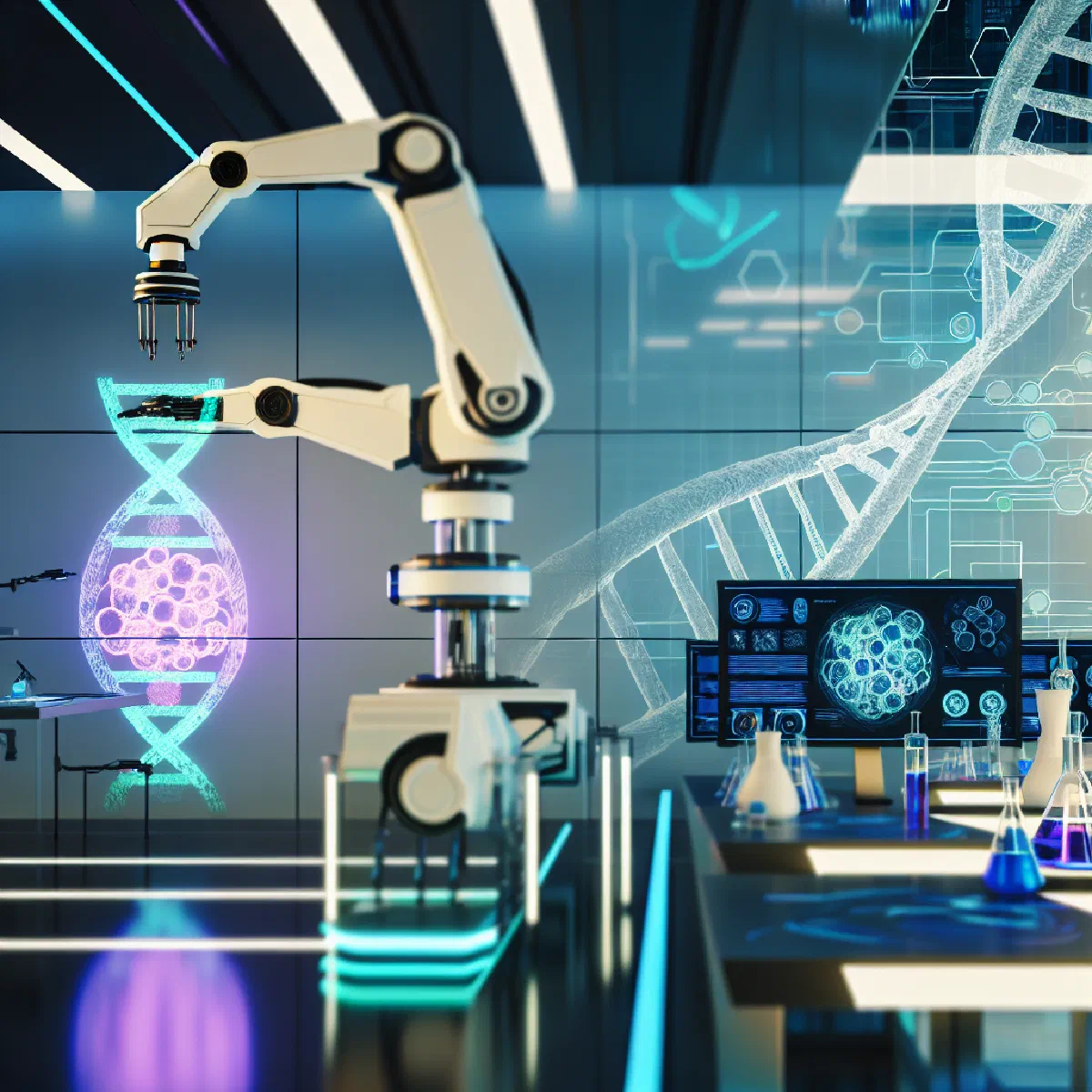
Explore Dario Amodei's insightful analysis on AI's potential to revolutionize biology, neuroscience, and innovation in the near future.
“I’m talking about using AI to perform, direct, and improve upon nearly everything biologists do,” Amodei writes.
Anthropic CEO Dario Amodei pens a smart look at our AI future
Summary
In his essay “Machines of Loving Grace,” Anthropic CEO Dario Amodei presents a methodical examination of artificial general intelligence (AGI), countering the often hyperbolic debate led by figures like Elon Musk and Sam Altman. Amodei, acknowledging the potential perils of AI, argues for its profound benefits, particularly in advancing fields such as biology and neuroscience. He proposes that by 2026, superintelligent AI systems, potentially resembling today’s large language models, could surpass human experts across disciplines, managing complex research autonomously and even collaborating with robots. This superintelligence is anticipated to tackle intricate biological systems, accelerating research breakthroughs—potentially reducing the timeline for innovations like CRISPR from centuries to decades. This acceleration might lead to significant public health advancements, the development of climate-mitigating technologies, and sustainable food solutions like lab-grown meat. Yet, Amodei acknowledges the obstacles, including data scarcity, computational limitations, regulatory apprehensions, and public skepticism stemming from misinformation. His vision underscores AI as an augmentative force rather than a replacement, resonating with the perspective that AI’s integration in human endeavors can democratize breakthroughs and perpetuate a technology-driven evolution across societies, ultimately aligning with the user’s advocacy for collaborative innovation through AI.
Analysis
The article featuring Dario Amodei’s perspective stands out by emphasizing the potential for AI to act as an augmentation tool rather than a replacement for human intelligence. This aligns with your viewpoint that AI should bolster human capabilities, particularly in driving innovation through collaboration. The essay’s strength lies in its balanced forecast for superintelligent AI by 2026, backed by specific examples such as advancements in biology and neuroscience, which underscores the user’s interest in technology-driven transformation. However, potential weaknesses in the article include an overestimation of the pace at which AI could address complex scientific challenges. While Amodei envisions rapid breakthroughs in areas such as cancer treatment and genetic disorders, the timeline may be overly optimistic given current AI limitations in truly understanding and autonomously navigating complex systems. Additionally, the discussion could benefit from deeper exploration of the societal and ethical implications of widespread AI deployment, especially in developing nations, considering your commitment to democratizing access to technology. The article could have more thoroughly addressed potential obstacles such as data privacy concerns, ethical dilemmas, and the socio-economic impact to provide a more rounded evaluation, ensuring readiness in the face of possible resistance stemming from misinformation or legislative caution.
Why customer tools are organized wrong
This article reveals a fundamental flaw in how customer support tools are designed—organizing by interaction type instead of by customer—and explains why this fragmentation wastes time and obscures the full picture you need to help users effectively.
Infrastructure shapes thought
The tools you build determine what kinds of thinking become possible. On infrastructure, friction, and building deliberately for thought rather than just throughput.
Server-side dashboard architecture: Why moving data fetching off the browser changes everything
How choosing server-side rendering solved security, CORS, and credential management problems I didn't know I had.
The work of being available now
A book on AI, judgment, and staying human at work.
The practice of work in progress
Practical essays on how work actually gets done.
The costume just got cheap
If 80 percent of what you thought was judgment turns out to be pattern recognition, what does that say about you? Not about your job — about you.
The bottleneck moved and nobody noticed
When execution becomes nearly free, the bottleneck shifts from doing the work to deciding what work to do. Most organizations are optimized for the wrong constraint.
The inbox nobody reads is the one that matters
Every organization has a monitoring system that works perfectly and reports to nobody. The gap between having information and acting on it is where most failures actually live.
Article analysis: 3 AI competencies you need now for the future
Master essential AI competencies to thrive in an evolving landscape and ensure your career remains irreplaceable in the age of artificial intelligence.
Article analysis: Unlocking autonomous agent capabilities with Microsoft Copilot studio
Unlock the potential of autonomous agents with Microsoft Copilot Studio, enhancing efficiency and innovation for businesses in the AI-driven landscape.
Article analysis: Are managers at risk in an AI-driven future?
Explore how AI reshapes management, emphasizing human-centric leadership and soft skills over technical expertise in the evolving workplace.